
GLEC 3.2 Update
GLEC framework has been updated to 3.2 version
Smart Freight Centre the organization behind GLEC has released the updated GLEC Framework 3.2. This update introduces updates to fuel emission factors and default intensity factors.
In this article, we will delve deeper into how BigMile will implement these updates and explain how they affect you as a user.
What Has Changed?
Most factors have been updated, with a notable increase in GHG values for fuel emission factors in North America
Implementing GLEC framework 3.2
The GLEC Framework undergoes an annual review to update its sources and methodology. Like last time with the 3.1 GLEC update, many emission factor changes are applied retroactively, replacing previous values.
Retroactive updates can present significant challenges, especially for users who have already calculated or reported their emissions or are in the process of external validation.
What is the right way?
We understand that transitioning between "old" and "new" factors can create uncertainty for organizations. Most updates reflect new scientific insights, increasing emission values for fuels like Diesel.
The scientifically accurate approach would be to recalculate emissions using the updated factors. However, we recognize this might not always be practical. After consulting auditing experts, we confirm:
- You can report using "old" factors for consignments if you:
- Are transparent: clearly communicate the version of factors used.
- Retain the ability to recalculate emissions using
the most recentfactors when required, which will be possible in BigMile.
Our implementation ensures you can meet both requirements. Additionally, you can see which framework version has been used in the reporting section of BigMile.
How has BigMile implemented these changes?
BigMile has Introduced "GLEC Advanced Settings" in the logistics profile:
- Users can now set a "Lowest version" and a "Maximum version"
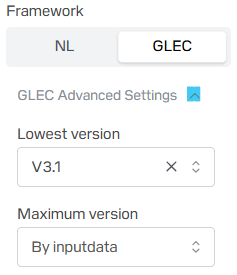
In order to understand what this lowest and maximum version does, it is important to first understand how these framework versions work:
- Emission factors are typically valid for the year after they come out, until a new version is released.
- BigMile determines which Framework version to use in the calculation, based on the shipment date of a consignment.
Along with the shipment date, BigMile also now looks at the 'GLEC Advanced Settings':
- If you put a certain framework version as the 'Lowest version', this means that we will never calculate with framework versions older than the version you selected.
- If you put a certain framework version as the 'Maximum version', this means that we will never calculate with framework versions newer than the version you selected.
In this way, by selecting the same framework version for both settings, you can make it so you always calculate with exactly the same framework version regardless of the shipment date.
You also have another option: 'By inputdata', choosing this option makes it so BigMile again looks only at the shipment date of your inputdata to determine which framework version to apply.
Adjusting settings in the logistics profile won’t recalculate your files automatically. To use the new settings, simply re-upload your files and while doing so, make sure to choose the updated logistics profile.
Changes from the GLEC 3.1 update that might be relevant for you to see if you missed them:
- For train, GLEC introduced an uplift of 12% for temperature controlled goods in GLEC 3.1. Users can indicate this via the temperature controlled column. By default we set is_temperature_controlled to False if it is not provided.
- Introduction of light & heavy for certain vehicle types
- Renamed vehicle types in line with 3.1:
| Old name | New name |
| Artic truck up to 40 t GVW | Artic truck 34-40 t GVW |
| Artic truck up to 44 t GVW | Artic truck 40-44 t GVW |